With the end of the traffic light coalition, Germany is facing a political reorientation that is also important for the startup scene. Verena Pausder, Chairwoman of the Startup Association, is calling for a ‘hands-on mentality’ in politics that will provide targeted support for startups. The Startup Association published proposals in September via #Innovationsagenda2030.
According to a survey conducted by infratest dimap on behalf of ARD-DeutschlandTrend, six out of ten Germans welcome the end of the traffic light coalition, with most of them blaming the FDP. The political instability could also raise concerns in the start-up scene, as founders could feel adversely affected by this situation. Verena Pausder, Chairwoman of the Startup Association, comments that there is a lack of the ‘hands-on mentality’ that would be necessary for an ‘entrepreneurial awakening’. ‘We cannot afford disputes and stagnation,’ says Pausder, pointing out the challenges for a future-oriented economy.
#InnovationAgenda2030: a catalogue of measures
In September 2024, the Startup Association published its #InnovationAgenda2030. This plan contains concrete measures to promote start-ups and outlines how Germany could strengthen the potential of the start-up scene. The key points of this agenda are
Attracting talent to the country: The association is calling for incentives instead of hurdles for top international talent in order to attract qualified specialists. According to the German Startup Monitor 2024, over 70% of the startups surveyed see a shortage of skilled labour as one of the biggest challenges.
Mobilise more private capital: The association is calling for measures to strengthen the venture capital market in order to increase investment. A study by EY 2023 shows that Germany is behind the UK and France in terms of VC financing in Europe.
State as a driver of innovation: The state should play a more active role in the field of innovation and provide targeted support for start-ups. In the EU Benchmarking Study 2023, Germany is ranked behind countries such as the Netherlands and Sweden in terms of ‘State Innovation Support.
According to the startup association, these measures would create a basis on which startups could continue to develop their innovative strength. ‘We don’t have a problem with knowledge in this country, we have a problem with implementation,’ commented Pausder in the statement on the catalogue of measures.
Timetable for the new elections and the demands of the startup scene
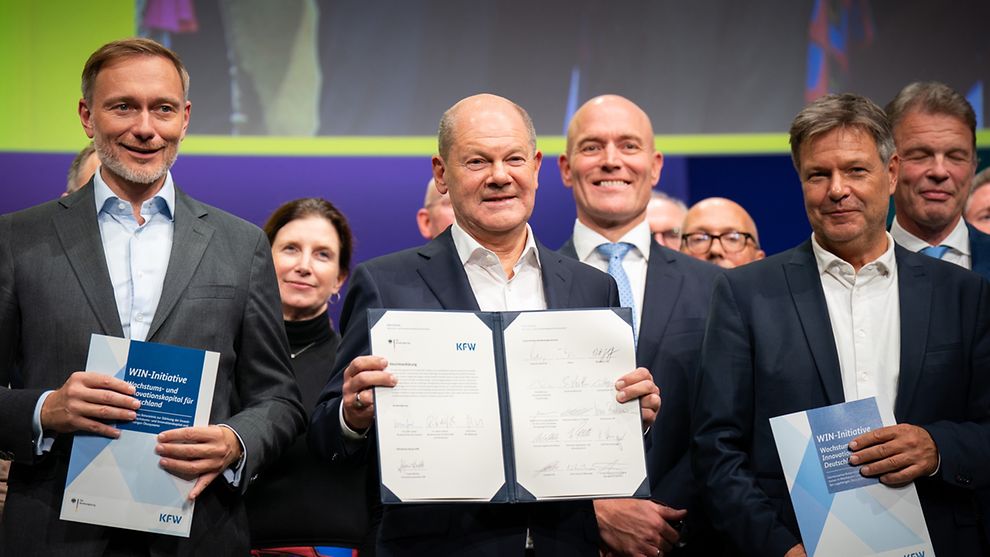
When all was still well with the world: Finance Minister Lindner, Federal Chancellor Scholz and Economics Minister Habeck after signing the joint declaration of intent for the WIN initiative. Photo: Federal Government/Kugler
The political uncertainty in the run-up to the next general election could hit start-ups hard. Olaf Scholz has announced that he will call a vote of confidence on 15 January, meaning that a new election would not be possible until March 2025. However, according to the ARD DeutschlandTrend survey, 65% of respondents believe that a snap election would be appropriate. A swift political decision would offer the startup scene more security, as the business climate is also influenced by stable political conditions (source: infratest dimap, ARD-DeutschlandTrend, November 2024).
Startup Port bündelt die Unterstützungsangebote und Gründungsberatung von zehn Hochschulen und Forschungseinrichtungen aus der Metropolregion Hamburg, Niedersachsen (Lüneburg) und Schleswig-Holstein (Wedel & Geesthacht) für Studierende, Forschende und Absolvent*innen bei der Vorbereitung ihrer technologie- und wissensorientierten Existenzgründungen. Informationen, Beratung, News und Evens.